
How to get approved for your first credit card in the US is one of the most confusing steps for newcomers, students, and anyone starting from zero.
You apply.
You get denied.
You apply again.
Denied again.
And suddenly you’ve made your situation worse.
Here’s the truth most people don’t realize:
Getting your first credit card is less about income — and more about positioning.
If you structure it correctly, approval becomes predictable.
If you do it randomly, you get stuck.
Let’s build this the right way.
Why Getting Approved Is Hard Without Credit
When you have no credit history, lenders see:
- No track record
- No payment history
- No credit score
- No proof of reliability
From a bank’s perspective, you are an unknown risk.
Not bad.
Not good.
Just unknown.
And unknown = risky.
So your goal is simple:
Reduce perceived risk.
Step 1: Understand Your Starting Position
Before applying for anything, clarify:
- Do you have SSN or ITIN?
- Do you have a US address?
- Do you have a checking account?
- Do you have steady income?
Even modest income is fine.
What matters is consistency.
Step 2: Open a Bank Account First (If You Haven’t)
This is underestimated.
Banks prefer customers with:
- Active checking account
- Direct deposits
- Stable balance patterns
If you already bank somewhere, your approval odds increase significantly.
Relationship banking matters.
Step 3: Choose the Right Type of First Card
There are 4 realistic starting paths:
1️⃣ Secured Credit Card (Safest Path)
You deposit money (example: $300).
That deposit becomes your credit limit.
Low risk for bank.
High approval odds for you.
Best for:
- No credit
- Immigrants
- Students
- Thin file
2️⃣ Student Credit Card
If enrolled in college:
Lower approval standards.
Designed for beginners.
Often small limits.
3️⃣ Authorized User Strategy
Be added to someone’s existing credit card:
- Good payment history
- Low utilization
- Old account
You inherit history.
This can generate score fast — but choose wisely.
4️⃣ Relationship-Based Approval
If you bank with an institution for 3–6 months:
You may qualify for an entry-level unsecured card.
Especially with direct deposit.
Step 4: Avoid These First-Card Mistakes
This is where most beginners fail.
❌ Applying for 4 cards at once
❌ Applying for premium rewards cards
❌ Ignoring income field accuracy
❌ Lying about employment
❌ Applying without checking pre-qualification
One denial is manageable.
Multiple denials hurt momentum.
Step 5: Use Pre-Qualification Tools
Many issuers allow soft-check pre-approval.
Soft checks do NOT hurt score.
This helps you avoid unnecessary hard inquiries.
Always check first.
Step 6: How Much Income Do You Need?
Many beginners assume:
“I need $50,000 income.”
False.
For beginner cards:
Even $15,000–$25,000 can qualify.
Part-time income counts.
Self-employment counts.
Stipends may count.
What matters is realistic reporting.
Step 7: If You Get Denied
Don’t panic.
Do this:
- Wait 30–60 days
- Fix whatever caused denial
- Reduce recent inquiries
- Try secured option
Denial isn’t permanent.
But reacting emotionally makes it worse.
Real-Life Example
Andrei moved to the US with:
- No credit history
- Part-time income
- One checking account
He applied for a premium travel card.
Denied.
Then applied for another major bank card.
Denied again.
Score impact: two hard inquiries.
We restructured.
He opened a secured card with $500 deposit.
Used it at 5% utilization.
Autopay enabled.
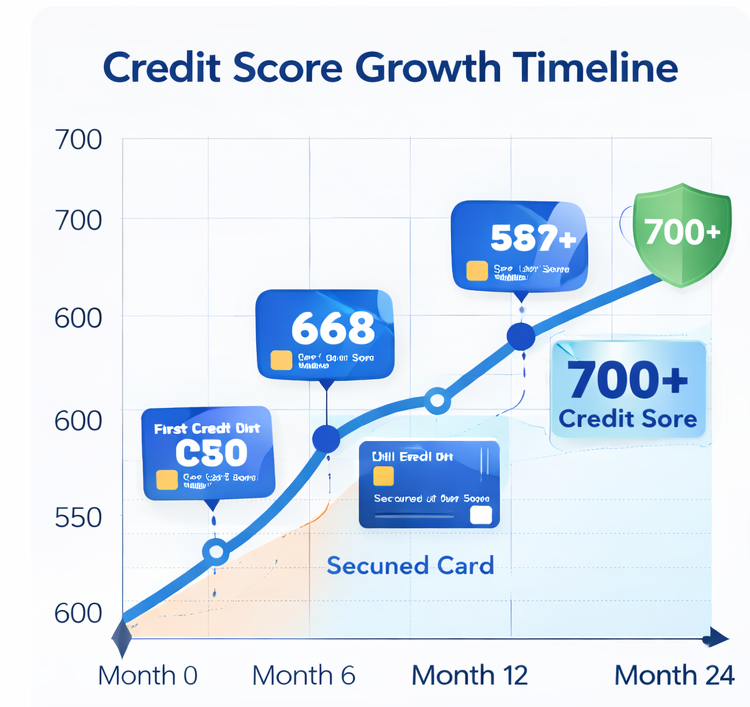
After 6 months:
Score generated: 698.
Month 8:
Upgraded to unsecured.
Month 12:
Approved for rewards card.
The difference?
Strategy.
How to Use Your First Card Correctly
Getting approved is step one.
Using it correctly determines your future score.
Rules:
✔ Keep utilization under 10%
✔ Pay statement balance in full
✔ Never miss payment
✔ Don’t close it early
✔ Avoid cash advances
Your first card is a credit foundation — not a spending tool.
Timeline After First Approval
Month 1–3:
- Score may not generate yet
- Focus on perfect usage
Month 4–6:
- FICO score likely appears
- Small limit increases possible
Month 6–12:
- Can apply for second card carefully
- Utilization strategy becomes key
How Many Cards Should You Have in Year One?
Ideal:
Year 1:
2–3 revolving accounts
More than that:
Risky.
Less than that:
Slow growth.
Controlled expansion wins.
FAQ – First Credit Card in the US
Can I get a credit card with no credit history?
Yes, secured or beginner cards are designed for this.
Does applying hurt my credit?
Hard inquiries may reduce score slightly.
Is secured card bad?
No. It’s often the smartest starting tool.
How long before I get a credit score?
Usually 3–6 months of activity.
Can immigrants build credit without SSN?
Some lenders accept ITIN, but options are limited.
Related Articles
- How to Build Credit in the US from Scratch
- What Is a Good Credit Score?
- Common Beginner Credit Mistakes
- How Long Does It Take to Build Credit?
- Safe Ways to Improve Your Credit Score
Final Thoughts
How to get approved for your first credit card in the US is not about luck.
It’s about preparation.
Banks don’t reward urgency.
They reward stability.
Start safe.
Grow methodically.
And within 12 months, you won’t just have a credit card.
You’ll have leverage.